BACK
A Parish Council’s Guide to Buying a Speed Sign (VAS)
9th November 2026
What should a parish council check before buying VAS signs?
Start with the road problem and your local highway authority’s requirements, then choose the sign type, location, power source, data features and mounting arrangement. Before ordering, ask for the product-level conformity and performance evidence that applies to the exact model. The right sign is not simply the brightest or cheapest one. It is the one your authority will permit and your council can operate reliably.
If your parish is dealing with repeated complaints about speeding, VAS signs can look like a straightforward purchase. In practice, the important decisions happen before you compare prices. You need to know what you want the sign to do, whether the proposed location is acceptable, how it will be powered and maintained, and what evidence the highway authority expects to see.
That matters because a vehicle activated sign is not a replacement for the statutory speed limit signs already on the road. The Department for Transport describes VAS as an additional measure that can warn drivers of a hazard or remind them of the speed limit in force. Your first conversation should therefore be with the local traffic or highway authority, not with a shopping list of products.
1. Start with the problem, not the sign
Before specifying any equipment, write down the problem you are trying to address. Is the concern a village entry where vehicles arrive too quickly? A residential road with repeated speeding complaints? A school approach? Or do you mainly need reliable speed data to understand when and where the problem is worst?
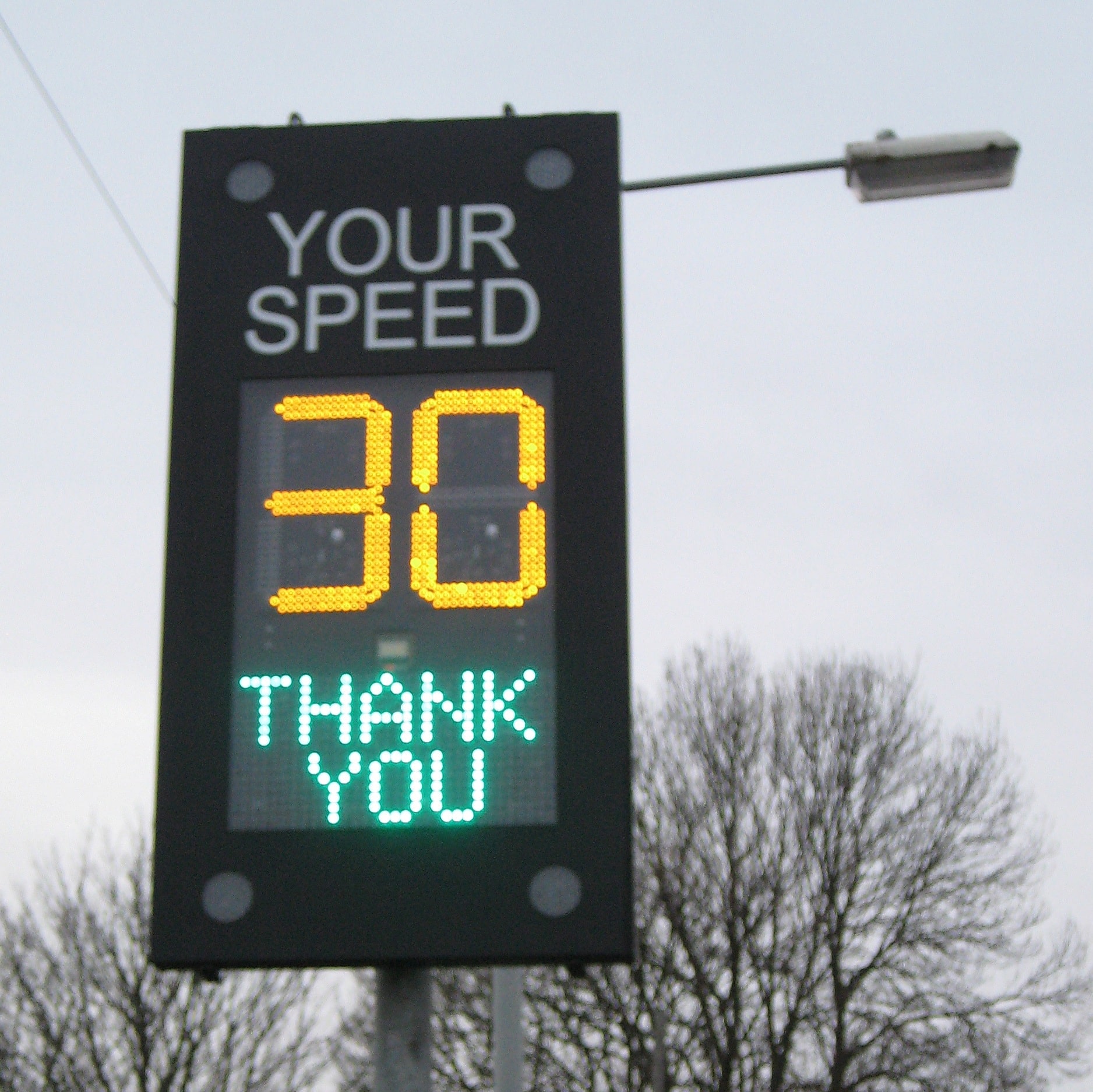
This distinction changes what you should buy. Some VAS signs display the legal speed limit and a warning message when an approaching vehicle exceeds the trigger threshold. A speed indicator device can show the driver’s measured speed. Other displays use a smiley or sad face to give simple feedback. These approaches all attract attention, but they do not communicate exactly the same thing.
The Department for Transport’s guidance on setting local speed limits says vehicle activated signs should be used as an additional measure, rather than as an alternative to standard static signing. That is a useful procurement principle: the electronic sign should have a clearly defined supporting job.
2. Speak to your highway authority before you buy
For a sign intended for the public highway, local approval is not an afterthought. TOPAS guidance written specifically for parish and town councils says procurers should check the traffic authority’s policies and procurement requirements and obtain consent. It also advises councils to check whether any other approval is required for the intended location.
Different highway authorities can have different rules for approved sites, mounting, movement between locations, training, power and operating periods. A model that works perfectly well in one county may not fit another authority’s local policy. Ask for the current local guidance before committing budget.
Ask your highway officer these questions first
- Does the authority permit parish-owned VAS signs or speed indicator devices on this road?
- Does the proposed site need a speed survey, collision history or other evidence?
- Which sign faces or display types are acceptable?
- Can the sign be permanent, or does it need to move between approved locations?
- What post, column, verge, visibility and access requirements apply?
- What technical or conformity documents must be supplied with the application?
3. Understand the difference between a VAS and a speed indicator device
The terminology can be confusing because suppliers and councils often use VAS as a broad label for electronic speed feedback signs. Procurement guidance makes a more useful distinction.
TOPAS describes a vehicle activated sign as a type of variable message sign that shows a regulated traffic sign face, such as a speed limit roundel, when triggered. It treats a speed indicator device, or SID, differently because a SID typically displays the driver’s detected speed or another feedback message rather than a prescribed speed limit sign face.
That difference matters when you are checking the applicable requirements. TOPAS says VAS sign faces on public roads should comply with the Traffic Signs Regulations and General Directions (TSRGD) and that VAS should meet BS EN 12966:2014. For SIDs, TOPAS recommends BS EN 12966 performance even though it describes them as outside the TSRGD scope. Its parish and town council procurement guidance also stresses that a conformity mark on its own is not enough: the supporting declaration needs to show what testing and standards it actually covers.
For a parish council, the practical lesson is simple. Do not ask only whether a radar speed sign is ‘compliant’. Ask the supplier to identify the exact product, the exact intended display and the evidence that applies to that configuration.
4. Choose what drivers should see
Once the highway authority has confirmed what is acceptable, choose the driver message that fits the problem. Messagemaker’s vehicle activated speed signs include different approaches rather than one universal display.
| Sign type | What the driver sees | When it may suit a parish |
|---|---|---|
| Speed Limit Reminder (SLR) | The speed limit roundel with a slow-down message when triggered | Where the priority is reinforcing the legal limit |
| Speed Indicator Device (SID) | The approaching vehicle’s measured speed, with a warning message | Where immediate personal feedback is useful |
| Smiley Activated Message (SAM) | Vehicle speed with positive or negative visual feedback | Where the council wants a softer, highly visible reminder |
If you are leaning towards a SID, look at the Speed Indicator Device specification rather than assuming every display works in the same way. Trigger behaviour, display duration, speed range, data options and mounting all affect how the device will work in your chosen location.
5. Treat siting as part of the specification
A good sign in a poor location is still a poor purchase. Drivers need enough approach visibility to see and process the message, while the installation needs safe access for fitting, battery changes or maintenance. The location also has to avoid creating unnecessary clutter or conflict with other traffic signs.
The Department for Transport’s Traffic Signs Manual provides the wider guidance used by traffic authorities for the use and siting of road signs. TOPAS also points procurers towards Chapter 8 or the Safety at Street Works and Road Works code of practice where installation work affects the highway.
For a mobile scheme, think beyond the first site. If the council intends to rotate VAS signs around the parish, agree every approved mounting location in advance and decide who will move the unit, how often, and how that work will be carried out safely. Buying a portable sign without an operating plan can simply move the problem from procurement to maintenance.
6. Compare battery, solar and mains power on whole-life practicality
Power is one of the clearest examples of why specification matters more than headline price. Messagemaker offers battery, solar and mains power options across its VAS range. Each can make sense in the right road environment.
- Battery power can make relocation easier, but somebody has to monitor charge, swap batteries and maintain the rotation.
- Solar power can reduce routine battery handling, but the proposed location still needs to suit the solar arrangement and the authority’s requirements.
- Mains power can suit a permanent installation where an appropriate supply is available, but installation is less flexible and may involve more infrastructure work.
Ask suppliers to explain expected operating behaviour for the actual configuration you are considering. Power demand depends on the display, activation pattern, communications and site conditions. ‘Solar’ or ‘low power’ is not a complete specification by itself.
7. Decide whether speed data is part of the job
For many parish councils, the data behind the sign can be nearly as useful as the display. Optional data capture on Messagemaker VAS signs can record vehicle speed together with the date and time of each record. A 4G option can also provide remote access for data download and settings such as trigger speeds and scheduling.
That can help a council move beyond anecdotal complaints. You can compare locations, identify time periods that merit closer attention and build a clearer evidence base for discussions with the highway authority or police. The data does not turn the sign into an enforcement camera, but it can make your local speed-management conversation more informed.
Before paying for data features, decide who will download the information, how often it will be reviewed and what decisions it will support. A feature has little value if nobody owns the process after installation.
8. Ask for product-level evidence before comparing quotes
Two quotations for VAS signs can look similar while covering different levels of technical evidence, mounting hardware, power equipment, data capability and support. Make suppliers quote against the same specification.
Your request should identify the intended site, display type, trigger behaviour, power source, mounting arrangement, data requirement and any local authority conditions already known. Then ask for the documents that support the exact model offered. TOPAS specifically advises councils to consider conformity documentation, calibration or speed-check reliability, traffic-count facilities and the standards relevant to the chosen product.
A practical quotation checklist
- Exact product and sign face being quoted
- Detection method and configurable trigger speeds
- Display size, brightness control and viewing arrangement
- Battery, solar or mains equipment included
- Post, bracket and mounting hardware included
- Data capture, download method and remote connectivity
- Conformity and performance documentation for that model
- Installation responsibilities and any training required
- Warranty, maintenance requirements and technical support
- Lead time and total delivered cost for the complete configuration
9. Do not buy on price until the scope is identical
A low headline price can be misleading if one quote excludes the solar kit, mounting plate, spare batteries, communications hardware or data function that another includes. The same applies to documentation and support. If your highway authority requires a particular evidence pack, that requirement belongs in the quotation request, not in a follow-up after the order is placed.
The most useful procurement comparison is therefore not ‘which sign is cheapest?’ but ‘which complete configuration meets the agreed need at the lowest sensible whole-life cost?’. That gives councillors a more defensible basis for approving expenditure and reduces the chance of buying equipment that later needs changing.
10. The buying sequence for a parish council
- Record the road-safety concern and what you want the sign to achieve.
- Contact the local highway or traffic authority and obtain its current policy.
- Agree suitable sites and whether the scheme will be fixed or mobile.
- Choose the display type: speed-limit reminder, speed indicator or feedback message.
- Specify the power, mounting, data and connectivity requirements.
- Ask shortlisted suppliers for model-level conformity and performance evidence.
- Compare quotations on an identical scope, including hardware, support and maintenance.
- Confirm approval and installation responsibilities before placing the order.
If you are at the stage of turning a local speeding concern into a specification, Messagemaker can help you compare its VAS signs , power options and data features against the application. You can also visit the Demo Room to see working VAS models and discuss how settings are changed before you request a quotation.
Frequently Asked Questions
Does a parish council need permission to install a VAS sign?
On the public highway, you should speak to the local highway or traffic authority before buying or installing equipment. TOPAS advises parish and town councils to check local policies, procurement requirements and consent, as well as any other approval needed for the intended location.
What is the difference between VAS signs and a speed indicator device?
In procurement guidance, the term VAS signs generally refers to vehicle activated traffic signs that can display a regulated sign face, while a speed indicator device normally shows the approaching driver’s measured speed or another feedback message. The distinction affects which technical requirements and evidence apply.
Can a vehicle activated sign replace normal speed limit signs?
No. Department for Transport guidance says vehicle activated signs should be an additional measure, not an alternative to the standard static signing that indicates the legal speed limit.
Should a parish council choose battery or solar VAS signs?
It depends on the approved site and operating plan. Battery power can suit a sign that is moved regularly, while solar can reduce routine battery handling where the location and local policy support it. Compare the complete power arrangement, maintenance workload and site constraints rather than choosing by label alone.
Can VAS signs collect traffic data?
Yes, some models can. Messagemaker offers optional data capture that records vehicle speed with date and time, with a 4G option for remote data access and settings. Decide what the council will do with the data before specifying the feature.
What evidence should we ask a supplier for?
Ask for the documents relevant to the exact model and intended use, not a general range statement. Depending on whether you are buying a VAS or SID and how it will be installed, this can include conformity documentation, the applicable performance standard evidence, declarations supporting the conformity marking and any product registration or authority-specific evidence required for the scheme.
Turn the speeding concern into a clear sign specification
Tell Messagemaker where the sign will be used, what you want drivers to see, whether the council needs data capture and how you expect to power or move the unit. The team can help you narrow the VAS range before you request a formal quote.